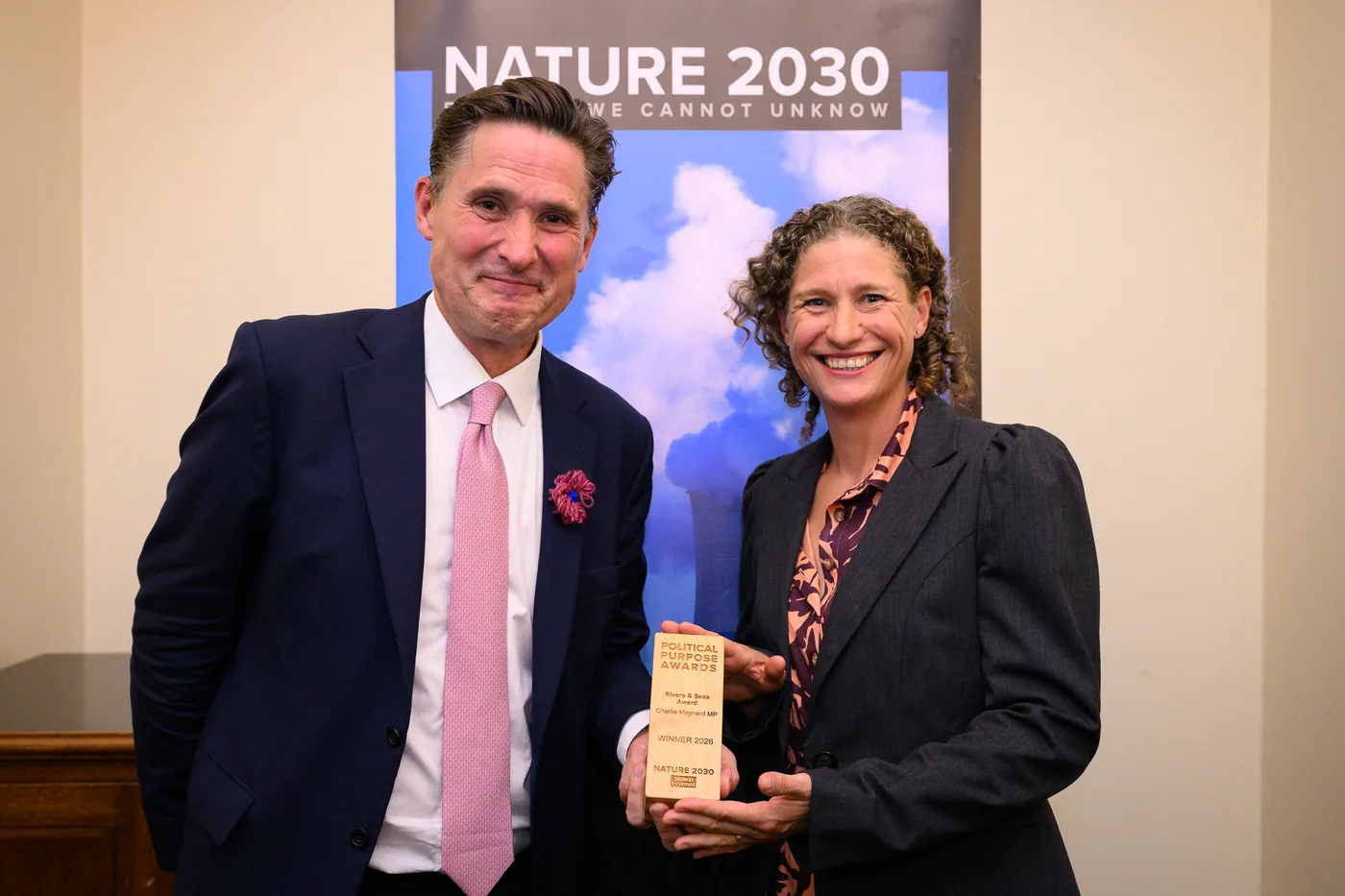
Charlie Maynard took Thames Water's £3bn plan to the Court of Appeal and won the Rivers and Seas Award. The district's 19 overflows spilled 677 times in 2025.
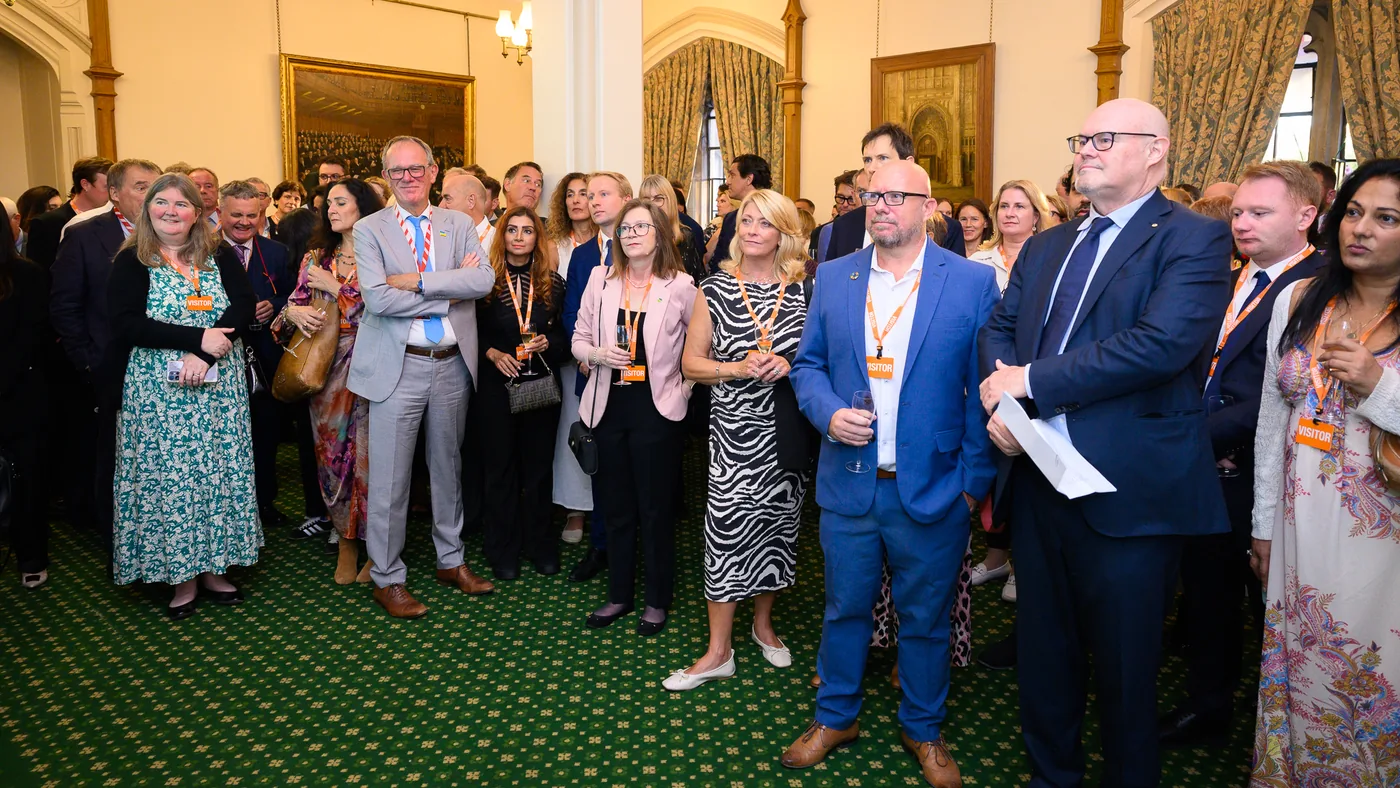
Witney’s MP has won a national environmental award for taking Thames Water to court. Charlie Maynard collected the Rivers and Seas Award at the Political Purpose Awards in the House of Commons on Tuesday 8 September.
The awards are run by the campaign group Nature 2030 and were presented for the fourth time this year, across ten categories, at a ceremony hosted by Ruth Jones MP. The Rivers and Seas category is sponsored by River Action UK. Alongside Maynard, the shortlist named three other MPs: Lloyd Hatton, Terry Jermy and Edward Morello.
The trophy is engraved “Rivers & Seas Award, Charlie Maynard MP, Winner 2026”.
What the award was for
In February 2025, Thames Water asked the High Court to sanction a restructuring plan that would lend the company about £3bn of new money. Maynard, who is a Liberal Democrat, was allowed to take part in the hearing as an intervener and argued that the plan was against the public interest, and that putting the company into special administration would be better and cheaper. His office says he was the first MP to bring a public-interest intervention of this kind, and that he acted on behalf of more than 25 parliamentarians and 34 charities.
Mr Justice Leech sanctioned the plan that month. Maynard then took it to the Court of Appeal, which heard the case over three days from 11 March 2025 and announced its decision on 17 March, with full reasons on 15 April. He lost the central argument. The court dismissed the appeal, but it did require one change to the plan, on the releases it granted to Thames Water’s directors and advisers.
He tried once more. The Supreme Court refused him permission to appeal on 28 July 2025, in a decision by Lord Reed, Lord Richards and Lady Simler. The case is recorded there as Charles Adrian Macfie Maynard v Thames Water Utilities Holdings Limited.
So the plan he fought went through, and Thames Water remains the company that treats Witney’s sewage.
What he told Parliament about the works around Witney
The case is the headline, but the detail that matters locally came earlier, in the committee that scrutinised the Water (Special Measures) Bill in January 2025. Maynard tabled and moved a run of new clauses, and he used them to name local treatment works.
In the fifth sitting, arguing that a £200m threshold for new procurement rules would miss almost every scheme that affects his constituents, he said:
In my patch in Witney, we have sewage treatment works as far as the eye can see that are undercapacity and are leaking sewage all over the place, at Bampton, Cassington, Carterton, Witney, Milton; you name it. It is awful.
In the same sitting he turned to new housing being connected to works that cannot cope, naming Witney, Ducklington, Bampton, Aston and Carterton:
When I quiz people from Thames Water about why they have waved it through, they say, “We have a duty to connect.” They do have a legal duty to connect, which they take seriously, but they take their duty to add capacity to match that increase much less seriously.
His other clauses were about the plumbing of the industry rather than the pipes:
- a duty on every water company to publish a map of its sewage catchment network, showing pumping stations, pipes and works, within 12 months and free on its own website
- a ban on water companies having offshore holding companies. He named one in the debate, Thames Water Utilities Cayman Finance Holdings Ltd, and asked why a UK-regulated water company needs it
- a power for a special administrator to write off up to 100% of a water company’s debts, while protecting wages and pensions
- a rule that the Secretary of State must apply for special administration when a company loses its investment grade credit ratings
On the maps clause he told the committee: “Frankly, it is pretty worrying that we do not have maps of sewer networks around the country.” He withdrew most of the clauses after debate. The one he pressed to a vote was new clause 19, which bundled financial stability, the offshore holding company ban and an annual reconciliation of regulated capital value against what a company’s shares and debt are actually worth.
He also gave the committee a local example of how cheaply monitoring can be done. Flow monitors cost £500 to £2,000 each, he said, before adding: “We did it much cheaper in west Oxfordshire and Witney. Well done to the Witney flood mitigation group. It got 10 installed for a fraction of that.”
The record on our own rivers
The Environment Agency published the 2025 storm overflow figures on 26 March 2026. They come from event duration monitors fitted at each site, and they count how often and for how long a storm tank or pumping station overflowed into a river or brook instead of the flow going through treatment.
We took the Thames Water sheet from that return, converted every grid reference to a point and kept the ones that fall inside West Oxfordshire. There are 19 monitored overflows in the district. In 2025 they spilled 677 times, for 9,981 hours between them, which is 416 days of discharge. The hours are the raw monitored total, before the counting rule that treats anything inside a 12 to 24 hour block as one spill.
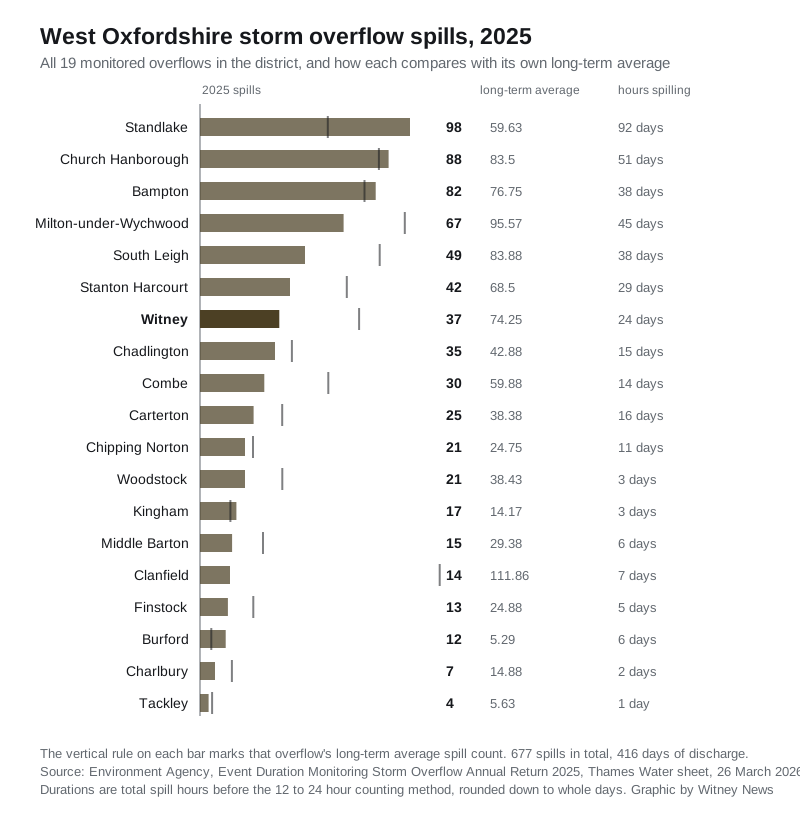
Standlake was the worst, at 98 spills into the Windrush over 92 days. It sits in the ward Maynard told the committee he represents as a district councillor, Standlake, Aston and Stanton Harcourt, and the Stanton Harcourt works is on the same list at 42 spills into the Harcourt Brook.
Of the five works he named in that quote, Bampton is the district’s third worst and Milton-under-Wychwood its fourth. Bampton spilled 82 times into the Shill Brook, over 38 days. Milton-under-Wychwood spilled 67 times into the Littlestock Brook, over 45 days. Carterton spilled 25 times into the same brook as Bampton. Witney’s own works, which discharges to the Curbridge Ditch rather than the Windrush, spilled 37 times over 24 days. The Cassington works is the exception: it sits just outside the district boundary, on the far side of the Thames, and it recorded no spills at all in 2025.
The return also gives a long-term average spill count for each overflow, which is the fairest way to judge whether 2025 was unusual. It was better than usual almost everywhere. The 19 overflows have a combined long-term average of 952.5 spills, against the 677 recorded last year, and only five were above their own average:
- Standlake: 98 against an average of 59.63
- Church Hanborough: 88 against 83.5
- Bampton: 82 against 76.75
- Kingham: 17 against 14.17
- Burford: 12 against 5.29, more than double
The largest fall was at Clanfield, which spilled 14 times against a long-term average of 111.86. That is also the one site in the district where the monitor was not running for almost the whole year, at 97.34% of the reporting period. Everywhere else it was above 99%.
What it means for you
The court case is finished and Thames Water’s restructuring went ahead, so nothing about this award changes who runs the sewers here or what your bill pays for. What it does give residents is a public record to hold the company to.
- Check your nearest overflow. The Environment Agency’s spill frequency portal maps every monitored storm overflow in England, and the underlying annual returns are free to download year by year.
- A spill is not automatically a breach. Storm overflows are permitted to discharge in heavy rain. The figures show how often that permission was used, not that a rule was broken.
- The capacity argument is a planning argument. Maynard’s complaint is that new homes are connected to works that are already at their limit. The district’s own infrastructure plan to 2043 lists 24 water and drainage projects costing £59.07m, with £1.75m of that unfunded, while the Local Plan proposes about 2,100 homes on Witney’s edge. Comments on that plan close on 9 October.
- Individual applications are where this bites. Drainage objections are made on the planning file, application by application, which we track on our Witney planning page.
Sources
- Political Purpose Awards 2026 winners and shortlists, Nature 2030
- Re Thames Water Utilities Holdings Ltd, 2025 EWHC 338 (Ch)
- Kington S.a.r.l. and others v Thames Water Utilities Holdings Limited, 2025 EWCA Civ 475
- Maynard v Thames Water Utilities Holdings Limited, UK Supreme Court case UKSC-2025-0101
- Water (Special Measures) Bill, Public Bill Committee, second sitting, 9 January 2025
- Fourth sitting, 14 January 2025
- Fifth sitting, 16 January 2025
- Event Duration Monitoring, Storm Overflows, Annual Returns 2025, Environment Agency
Have your say