Witney needs 1,412 more primary places and 786 secondary places by 2043. More than half of West Oxfordshire's £604m infrastructure gap is schools.
The Witney area will need 1,412 more primary school places and 786 more secondary places by 2043, and almost none of the money is in place. The figures come from the Infrastructure Delivery Plan that West Oxfordshire District Council published on 2 September as evidence for its draft Local Plan 2043.
The council put the headline number in its own announcement: 271 projects, £1.51 billion of investment, and a £604 million funding gap. What the announcement does not say is where that gap sits. Read the document and it is overwhelmingly schools.
Comments close on Friday 9 October.
Where the £604m gap actually is
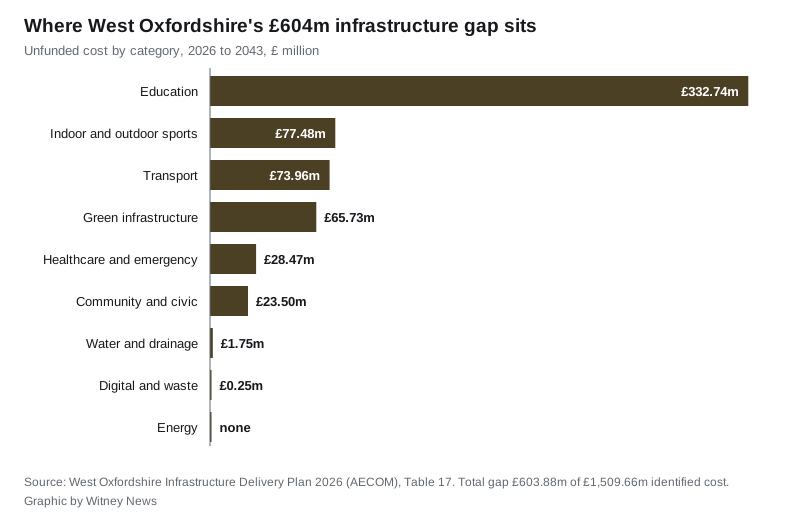
The plan splits every identified project into nine categories. Education accounts for £332.74 million of the £603.88 million gap, more than every other category put together.
| Category | Projects | Identified cost | Funding gap |
|---|---|---|---|
| Education | 22 | £375.96m | £332.74m |
| Indoor and outdoor sports | 27 | £96.92m | £77.48m |
| Transport | 90 | £411.54m | £73.96m |
| Green infrastructure | 19 | £134.67m | £65.73m |
| Healthcare and emergency services | 16 | £371.53m | £28.47m |
| Community and civic facilities | 41 | £25.20m | £23.50m |
| Water and drainage | 24 | £59.07m | £1.75m |
| Digital and waste | 7 | £31.40m | £0.25m |
| Energy | 25 | £3.38m | £0 |
| Total | 271 | £1,509.66m | £603.88m |
Education is not the most expensive category. Transport is. The difference is who is assumed to pay. The report is explicit that healthcare is expected to lean on NHS funding and utilities on the regulated water and energy companies, while schools are expected to lean on developer contributions. Only £4.24 million of the £375.96 million education bill is currently secured.
The number the press release leaves out
£1.51 billion is not the full bill. The report states that only 153 of the 271 line items have a cost against them at all. Most of the missing ones are transport and energy projects, where the scope is not settled enough to price. In the report’s own words, the total for those two topics “will be significantly higher than presented”.
Several very large projects are also excluded from the table because they serve more than West Oxfordshire, among them the £6.6 billion Abingdon reservoir, the £800 million Botley West solar farm, and Thames Water’s £161 million leakage reduction programme. So is the Carterton to Witney to Oxford Mass Rapid Transit corridor, which has no cost attached to it anywhere in the document.
What the Witney area is carrying
The plan divides the district into six sub areas. Witney’s, which takes in Ducklington and Minster Lovell as well as the town, is the largest by some distance.
- 5,040 homes between 2026 and 2043, from 150 completions, 2,230 commitments, 2,180 new allocations and 490 expected windfall
- 11,230 more residents
- 1,412 more primary school places, which the report equates to 6.7 forms of entry
- 786 more secondary places, 5.2 forms of entry, plus 314 more sixth form places
Four sites account for most of it: the North Witney strategic development area at 1,250 homes, and three new allocations of 700 homes each, north of Burford Road, south of Witney and west of Witney.
On secondary provision the report says Oxfordshire County Council has identified a need through its Pupil Place Plan but has no specific proposals. The one committed project is a £4 million science and art building at Wood Green School, approved in March 2025, started that April and expected to finish this month. Where the rest of the capacity goes is recorded in the schedule as “school location to be determined”.
Witney’s sewage works: £16m spent, still not enough
The district council has been unusually blunt about sewers, and the evidence base backs it up.
Witney sewage treatment works has just been upgraded at a cost of more than £16 million, lifting treatment capacity from 240 to 399 litres per second. That work finished in 2026. Even so, the report concludes that the permitted dry weather flow at Witney “will be exceeded by the end of the plan period”, though by less than 25 per cent.
Nine of the plan’s proposed sites drain to Witney works, totalling 6,215 homes. On top of those sit two sites already adopted in the 2041 plan, the North Witney SDA at 1,250 homes and Woodford Way car park at 80, plus existing permissions for another 1,817 homes. Thames Water may need a permit variation and further upgrades before all of it can connect.
The council’s answer is a planning tool called a Grampian condition, which stops new homes being occupied until the sewer capacity is actually delivered. It is already using them. The draft plan proposes to keep doing so.
The council is asking the government for help
Alongside the plan, council leader Cllr Andy Graham has published an open letter to government, regulators and infrastructure providers. Its argument is that the council can identify what is needed but cannot compel a nationally regulated water company to build it, or say when.
Cllr Liz Leffman, executive member for planning and infrastructure, put the same point in the council’s announcement: “Over the past two decades we have seen growth without the sewage treatment capacity, schools, healthcare and transport infrastructure we need. We don’t want to repeat that.”
The draft plan also tightens the rule on individual sites. Any development of more than 10 homes would have to produce its own infrastructure delivery plan.
What it means for you
If you have a child who will start school in Witney in the next decade, the number that matters is 1,412, and the fact that £4.24 million of a £375.96 million education bill is secured. The plan’s job is to make developers pay the rest. Whether it succeeds depends on a planning inspector accepting the evidence, which is what this consultation feeds.
If you live on a street that has flooded or backed up, the Grampian conditions are the practical lever, and the plan proposes to keep them.
If you drive, note what is missing rather than what is listed. The Mass Rapid Transit corridor between Carterton, Witney and Oxford is safeguarded in the plan but has no cost and no funder in the evidence. Land is being protected for it, not money.
This is the last stage before the plan goes to a government inspector. After 9 October the council cannot reopen it. Comments have to be about whether the plan is legally compliant, properly prepared, justified by evidence and deliverable, so “I object” on its own carries little weight; a comment that says the education funding assumption is undeliverable and explains why carries a great deal.
You can read the plan and comment through the council’s Your Voice consultation portal.
We set out where the homes themselves go, and the three areas on Witney’s edge, in West Oxfordshire Local Plan: 2,100 homes on Witney’s edge. Our running list of what the council is deciding is at Witney planning news.
Sources
- West Oxfordshire Infrastructure Delivery Plan 2026, AECOM for West Oxfordshire District Council, for Table 17 (costs, funding and gap by category), Table 13 and Table 14 (Witney sub area growth and sites), the primary and secondary school demand figures, the note that 153 of 271 line items carry costs, the excluded sub regional projects and the Witney sewage treatment works assessment.
- 271 infrastructure projects needed, one clear message: infrastructure must be a priority for West Oxfordshire, West Oxfordshire District Council, 2 September 2026, for the headline figures, the quotes and the 9 October deadline.
- Open letter from the leader of West Oxfordshire District Council on the Regulation 19 consultation.
- West Oxfordshire pre-submission draft Local Plan 2043, the consultation itself.
Have your say