
The Budget says a Thames Valley mayor deal for Oxfordshire, Berkshire and Swindon is in its final stages. West Oxfordshire takes it up in December.
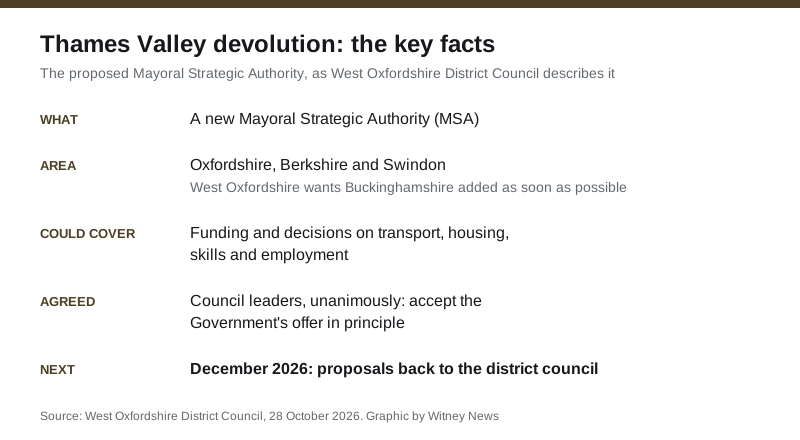
Witney could end up under a mayor for the Thames Valley. Council leaders across Oxfordshire, Berkshire and Swindon have agreed unanimously to accept “in principle” the Government’s offer of a new Mayoral Strategic Authority for the three areas, and to work up detailed proposals.
West Oxfordshire District Council announced on Wednesday 28 October that it welcomes the agreement. Nothing is settled yet. The detailed proposals will come back to the district council for consideration in December, and the council says there will be “opportunities for public engagement as the process progresses”.
The Budget: “final stages”
Later the same day, the Government’s Budget 2026 document listed the Thames Valley among 10 areas where it says it is “now in the final stages of agreeing” a devolution deal. It names a “Thames Valley (Oxfordshire, Berkshire and Swindon)” Mayoral Strategic Authority alongside new mayoral authorities for areas including Surrey, Hertfordshire, Lancashire and Wessex, and says the 10 deals would mean “over 90% of England’s population will have a devolution agreement in place”.
The Budget does not give a date for a Thames Valley mayoral election or say how much money would come with the deal.
What the local MP says
Sean Woodcock, the Labour MP for Banbury, whose seat takes in the north of our patch including Chipping Norton and Charlbury, welcomed the Budget confirmation. His office said he has campaigned for a Thames Valley authority “for some time”. In a statement, Mr Woodcock said:
“I am delighted with the news that there will be a new Mayoral Strategic Authority for the Thames Valley region. It is undeniable that this will bring much needed inward investment and empower local leaders to control the decisions that shape our area.
“The Thames Valley region has already proven itself as an engine of growth, with world-leading research and high-tech hubs consistently generating billions in economic output each year. Therefore, granting these local powers will help us to tackle infrastructure-based problems such as transport, and as such, further accelerate growth that is already happening in the area.
“I look forward to supporting the creation of this new mayoral authority and seeing the investment it will bring to our area.”
A week earlier, he and fellow Labour MP Peter Swallow made the case in an article for LabourList (21 October), naming the road Witney commuters know best: “The A40 regularly struggles to cope with demand.” They wrote that devolution across the Thames Valley “would give local leaders more influence over transport, skills and economic development”, and that in Oxfordshire the problem “is compounded by unreformed two-tier governance”. The article puts Oxfordshire’s economic output at £23.5 billion in 2020.
The “inward investment” Mr Woodcock expects is his forecast: neither the Budget nor the council’s announcement puts a figure on it.
What a strategic authority would do
The council describes the new body as one that “could give local leaders greater control over funding and decisions on transport, housing, skills and employment”. It says the agreement follows “a long period of collaboration between councils across the region” on economic growth, infrastructure and investment, and that the authority “could bring significant new powers and investment to the region”.
The announcement does not say how much money would come with the deal, when a mayor would be elected, or which decisions would move from the county and district councils to the new body. Those are the questions the December proposals will need to answer.
What the council leader says
Councillor Andy Graham, Leader of West Oxfordshire District Council, said:
“I’m delighted that we’ve reached unanimous agreement to move forward with these proposals. It’s been a long road to get here, and the progress we’ve made shows what can be achieved when councils work together with a shared ambition for our communities.
“For West Oxfordshire, this is an opportunity to take a more joined-up approach to infrastructure and investment across the region. Too often in the past, decisions about housing, transport and other infrastructure have been made separately, rather than as part of a wider plan. Devolution could help us bring these things together, plan more strategically and make sure growth delivers real benefits for local people.”
That point will be familiar to anyone who has followed the district’s big infrastructure arguments this year, from the West End Link Road, kept in Witney’s transport plan only as a study, to the A40 works between Eynsham and Cassington and the new Local Plan that sets where homes go.
The case for adding Buckinghamshire
The council wants the map drawn wider than the three areas in the offer. Cllr Graham said:
“We also recognise the importance of aligning the new authority with existing public services, particularly across health, policing and fire and rescue. We believe Buckinghamshire should be brought into the arrangements as soon as possible to help strengthen those existing partnerships.”
He added:
“Above all, it’s important that West Oxfordshire has a strong voice as these plans develop, and that our towns, villages and rural communities share in the opportunities this could bring.”
What it means for you
- Nothing changes yet. Your bins, council tax and planning decisions stay with the same councils. Agreement “in principle” is a decision to keep working on the proposals, not to create the authority.
- December is the next local step. The proposals go back to West Oxfordshire District Council then. The council’s meetings calendar will carry the papers once they are published, and we will report what they contain.
- You should get a say. The council promises public engagement as the plans develop, but has not yet said how or when.
- This is not the same as the council being abolished. A separate government plan to replace West Oxfordshire District Council with a new unitary council was paused in September. The council’s announcement does not say how the devolution proposals relate to that review.
Sources
- West Oxfordshire District Council, West Oxfordshire welcomes progress on Thames Valley devolution deal, 28 October 2026, also sent to Witney News by email the same day.
- HM Treasury, Budget 2026, 28 October 2026, devolution agreements.
- Office of Sean Woodcock MP, statement sent to Witney News by email, 28 October 2026.
- Peter Swallow MP and Sean Woodcock MP, ‘The Thames Valley is driving growth. Devolution can turbocharge it.’, LabourList, 21 October 2026.
Have your say