

Healthwatch Oxfordshire, the county’s independent health and care watchdog based at Elmfield House in Witney, will stay after the government withdrew its plan to abolish local Healthwatch organisations.
The Health Bill had included proposals to abolish Healthwatch England and every local Healthwatch. On 28 October the government announced that those proposals were being withdrawn, and that Healthwatch England and local Healthwatch organisations would instead be “retained and strengthened”. Healthwatch Oxfordshire says the Bill is in its committee stage and should complete by early 2027.
In its news briefing on 5 November the charity said: “We are so pleased that the importance of having an independent public voice in health and care has been recognised and protected. The decision means we can continue our vital work listening to local people, sharing their experiences, and helping to shape better health and care services across Oxfordshire.”
Why abolition was proposed
According to Healthwatch Oxfordshire’s own account, the government had said several organisations were involved in gathering feedback about care, and that bringing responsibilities together could make services more joined up and cut duplication. Its plan was to move the job of listening to patients and the public into the organisations that already plan and oversee care locally, rather than leaving it with independent Healthwatch bodies.
Local Healthwatch organisations across England argued for the opposite. In Oxfordshire, the charity says, support for keeping an independent voice was unanimous: Oxfordshire County Council endorsed the principle, and the Oxfordshire Health Overview and Scrutiny Committee and the Oxfordshire Health and Wellbeing Board said the same.
“Despite the uncertainty of recent months”
Dr Veronica Barry, Executive Director of Healthwatch Oxfordshire, said in the charity’s response to the announcement:
“We are pleased that the principle of an independent public voice in health and care has been valued, recognised and protected, and as such the proposed abolition of local Healthwatch has been withdrawn. We are delighted that this means Healthwatch Oxfordshire can continue its vital work listening to local people and amplifying their voices to help shape health and care services.
“It is so important that people know they have a trusted, independent organisation they can turn to to share their experiences of health and care services, knowing that their voices will be heard and used to help bring about positive change.
“We are very grateful to everyone who has shown support for Healthwatch over the past 18 months. Across Oxfordshire there has been unanimous support for maintaining an independent voice in health and social care, and I would like to thank our health and care system partners, local councils, Patient Participation Groups and community organisations who have spoken up about the importance of our role.
“I’d also like to thank our staff team, trustees and volunteers, who have remained committed and continued to work tirelessly despite the uncertainty of recent months.”
She added that the decision “provides an opportunity to strengthen the role of Healthwatch and ensure that the experiences, concerns and priorities of local people play an even greater part in shaping services for the future.” Healthwatch England has published its own statement.
Its latest visit: hearing loops at the JR’s MRI department
The watchdog’s work carries on in the meantime. In October it published a report on its Enter and View visit to the Oxford Magnetic Resonance Imaging department at the John Radcliffe Hospital in Oxford. Healthwatch has statutory powers to visit publicly funded health and care services and report on what works and what could be better.
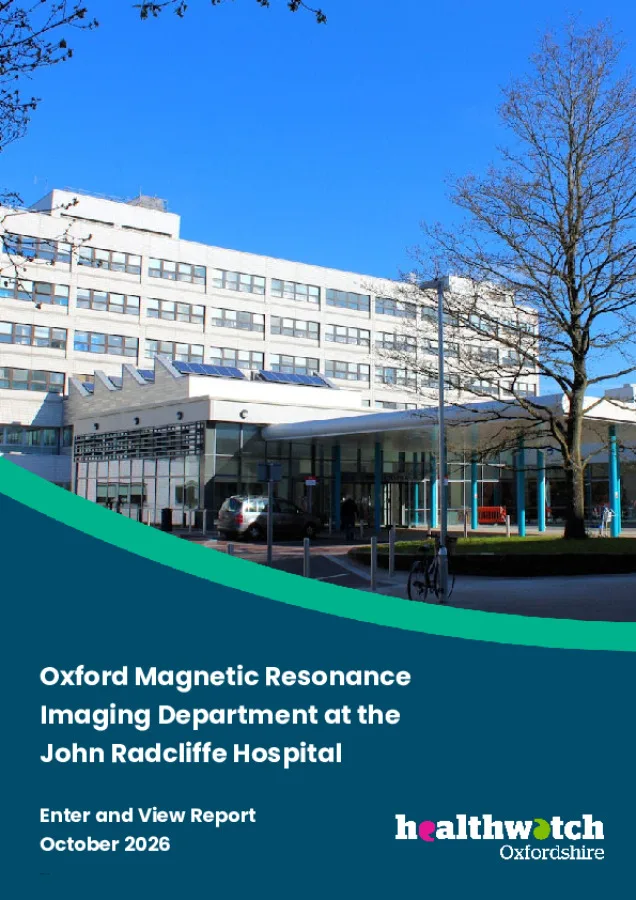
Two representatives spent three hours in the department on 28 April and heard from four patients, one carer and 17 staff. They found it “very clean”, with a “warm and friendly atmosphere”, and patients described staff as “caring, committed and friendly”. They also found no clear signs to the department from the main entrance, no translated leaflets, no information on reaching an interpreter, no hearing loop, no Care Quality Commission report on display, water leaks in the changing rooms and staff room, and, again, complaints about parking.
The report made eight recommendations. In its reply, Oxford University Hospitals NHS Foundation Trust said hearing loops “have now been purchased and installed” in the department and in the main radiology department in the West Wing, the CQC report is now on display in both, and the leaks have been fixed. It said it would review signs from the main entrance with its estates and wayfinding teams, review translated information and make interpreting services easier to find. On parking it called the problem “a Trust-wide issue”. On the staff workload the report raised, it said MRI demand had risen and that teams were “using additional scanners where possible”, but not every scan can be done at every site.
The rest of October
The snapshot of its October work includes presenting its rural health and wellbeing research to district councillors in West Oxfordshire and Cherwell. That report heard from more than 850 people in 14 rural communities, among them Chipping Norton, Charlbury, Freeland, Long Hanborough and Faringdon; we reported its findings on 5 November.
It also ran two more skills workshops for would-be community researchers, bringing the number trained since August to 24, visited Bicester Community Hospital and Oxford’s Older People’s Day, and supported health promotion days run by the Bloxham and Hook Norton surgeries and their Patient Participation Group.
A recording of its October webinar on what makes a successful Patient Participation Group is on its webinars page. The next webinar, on Neighbourhood Health, is on Tuesday 19 January from 1pm to 2pm, with details to follow.
What it means for you
Anyone who has used a health or social care service in Oxfordshire can still tell an independent body about it. The charity says what people tell it “helps show what is working well, what is not working, and where health and care needs to improve.”
- Call Healthwatch Oxfordshire on 01865 520520 or email hello@healthwatchoxfordshire.co.uk.
- Leave an anonymous review of a hospital in Oxfordshire through its Feedback Centre; it says it takes a few minutes.
- Its support hub lists local health and care services and organisations.
Have your say