
Chipping Norton and Faringdon are among the four places with the lowest self-reported mental health in a survey of 14 rural Oxfordshire communities, in which Charlbury, Freeland and Long Hanborough residents also described costly buses, lost services and homes they cannot afford.
The research comes from Witney-based Healthwatch Oxfordshire and Community First Oxfordshire, which heard from 851 people for Oxfordshire County Council. The 14 places were chosen because data and local intelligence showed “significant pockets of health inequalities”. The full report came out on 21 September, and Healthwatch has now added a summary sheet for each community. It says those sheets show what people said and how their views will be used.
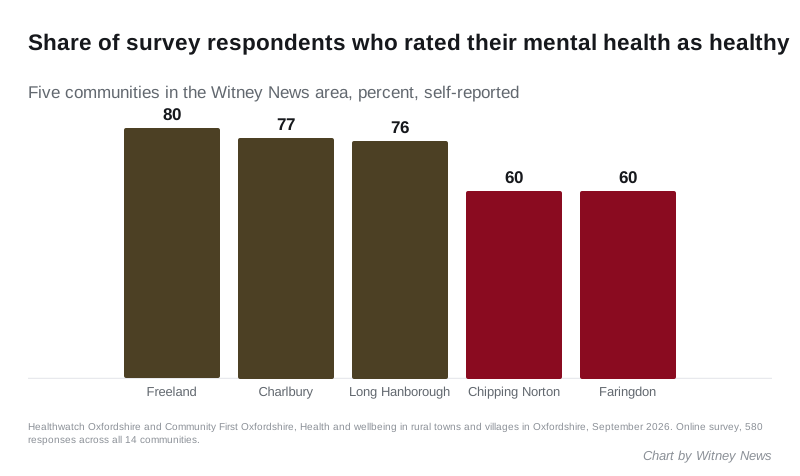
Sixty per cent of people answering the online survey in Chipping Norton and in Faringdon rated their mental health as healthy, against 72% of all participants. Only Heyford Park and Yarnton were lower, at 56%, and Heyford Park’s figure rests on nine responses. Freeland scored 80%, Charlbury 77% and Long Hanborough 76%.
Physical health followed a similar pattern. In Faringdon 48% called themselves healthy, in Chipping Norton 59%, in Charlbury 66%, in Long Hanborough 68% and in Freeland 81%. Across all 14 places the figure was 63%.
These are small samples: 580 online responses across all 14 places. The report says the survey leans towards older and more financially comfortable people, so the figures are a guide to who answered rather than a measure of each town.
The sharpest divide was money. People who said they were financially “not comfortable” were three times as likely to report poor physical health as those who were comfortable, at 27% against 9%, and four times as likely to report poor mental health, at 24% against 6%. Of the “not comfortable” group, 92% said the cost of living was affecting their ability to look after their health. People aged 25 to 49 also fared worse than their elders: 17% reported poor mental health, against 4% of those aged 65 to 79 and 2% of those aged 80 or over.
Chipping Norton: “nothing for young people that’s free”
Residents praised the town’s friendliness, its walkable size, the Chippy Larder and The Branch community hub. “There’s always somebody to advise you or help you or just give you a smile,” one person told a focus group. Topside Pharmacy and being able to see a named GP also won praise.
Transport and education drew the strongest complaints. “I went with my children to Witney on the bus and it cost me £17.90,” one parent said. Another described the choice facing teenagers: “If you do A-levels, you can stay at your local school. If you don’t do A-levels, you’ve got to go on a bus for an hour, starting really early.”
Health services came up too. “So there’s no Minor Incident Unit, first aid real service in Chipping Norton,” one participant said, and the report gives Moreton-in-Marsh, 8 miles away, as the nearest Minor Injuries Unit. Another said some women’s health services now mean a trip to Banbury or Oxford. The report also records concern that about 750 proposed homes will add to the strain on roads, parking and stretched health services.
On young people, one focus group member was blunt: “There is one massive gaping hole in the groups. So there is nothing for young people that’s free to access.” Job services mean a journey as well: “If you’re working part-time on Universal Credit, you get called to an interview. You’ve got to go all the way to Witney.” The Chipping Norton summary sheet sets out the main points.
Charlbury: “it falls too much on too few”
Charlbury was among the most contented places: 91% of those asked were satisfied or very satisfied with living there. “The place is vibrant the whole time for every age group,” one person said.
The worries were housing, loneliness and who gets left out. “I grew up here and it’s a lovely place, but it’s being ruined by second home owners, extortionate house prices and gentrification,” one survey response said. “It’s almost impossible to stay here as a young person who grew up here.” Another resident told a focus group: “I know I have my times when I’m incredibly lonely, and if I didn’t have my little rescue dog, it would be awful.”
Volunteers are thinning out as well. “Scouts has stopped at the moment because we’ve got no one to run it,” a focus group heard. Read the Charlbury summary sheet.
Long Hanborough: a Local Plan paper and residents disagree

The report quotes West Oxfordshire’s 2025 Local Plan consultation paper, which calls Hanborough “relatively well served by community infrastructure”, with a modern GP facility and a dentist. The passage does not say whether that dentist takes NHS patients, and the report lists a lack of an NHS dentist in the village among residents’ concerns.
“NHS dental services no longer in Hanborough unable to find alternative,” one wrote. “NHS GP no service outside business hours, makes no sense in a village of commuters.” Another said: “Roads, footpaths and pavements are dangerous through unattended potholes, sloping pavements and lack of upgrading roads despite population substantially increased.”
The report counts three major developments since 2017, of 128, 175 and 50 homes, with 150 more consented since 2023. “As with many rural communities, Hanborough struggles a little with the weight of fast expansion and an infrastructure that hasn’t kept up,” one resident said. Others valued the station, the shops and the community path through Blenheim Park. Read the Long Hanborough summary sheet.
Freeland: “a lovely village but transport is a disaster”
Freeland had the best physical health score of the 14 places, and 93% were satisfied or very satisfied with living there. It also leans heavily on other places: 63% said they meet most or all of their daily needs outside the village.
“It’s a lovely village but transport is a disaster,” one resident wrote. “There is a community bus but it only runs once every 2-3 hours and doesn’t run at all outside of 9 to 5.” A disabled resident said: “Unable to access public transport independently. Feel that I am part of a forgotten group of people.” The report says work is under way to reopen the village shop, and residents also raised speeding on Wroslyn Road. Read the Freeland summary sheet.
Faringdon: “if you haven’t got a smartphone”
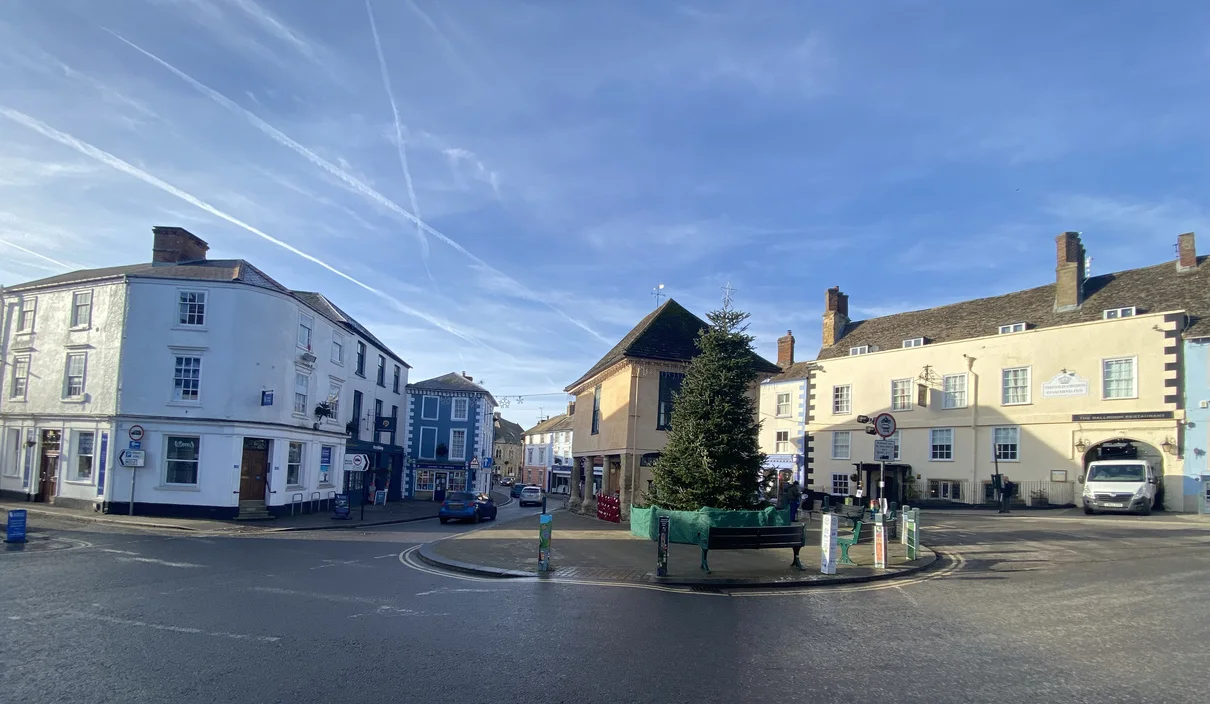
Faringdon recorded the lowest satisfaction of our five communities, at 67%, though that sits beside real warmth for the town’s groups and its GP-run activities. “It’s such a welcoming space for new initiatives,” one newcomer said.
The complaints were buses, NHS dentistry and parking. The report notes that links to Witney’s care homes and community hospital are among the transport gaps, and says an NHS dentist for Faringdon is being commissioned. One participant said: “I feel my age group seems to be being pushed further and further to the edge of society. If you haven’t got a smartphone it’s very hard to access things.” Read the Faringdon summary sheet.
What the report asks for
The authors call for an integrated transport network, more support for teenagers, housing that is “genuinely” affordable, health care nearer to home, and infrastructure provided before new homes rather than after. They also warn that progress must not be “lost in local government reorganisation”, which matters here because the Government is “minded to” put West Oxfordshire into a new Northern Oxfordshire Council.
They also caution against leaving it to volunteers. “There is only so much that volunteer and community-based groups, constricted in so many ways by funding, time, and the pool of available volunteers, can be expected to achieve and deliver,” the report says. It adds that the county council will use the findings to inform its work, and Healthwatch says it presented them to district councillors in West Oxfordshire and Cherwell in October.
Healthwatch itself is staying
The body behind the research faced abolition under the Health Bill until last week. On 28 October the Government announced that Healthwatch England and local Healthwatch organisations would be kept and strengthened.
Dr Veronica Barry, Executive Director of Healthwatch Oxfordshire, said: “We are pleased that the principle of an independent public voice in health and care has been valued, recognised and protected, and as such the proposed abolition of local Healthwatch has been withdrawn. We are delighted that this means Healthwatch Oxfordshire can continue its vital work listening to local people and amplifying their voices to help shape health and care services.”
She added: “Across Oxfordshire there has been unanimous support for maintaining an independent voice in health and social care.”
What it means for you
- See your community’s sheet: the report page has the full report, an easy read summary and all 14 sheets. For a printed copy, call 01865 520520.
- Community research grants have now closed: grants of up to £2,500 for community-led research into local inequalities and wellbeing closed on 6 November. The Oxfordshire Community Research Network fund totals £25,000, from the county council. Healthwatch says 24 community researchers have completed its training since August.
- Tell someone about your GP: Healthwatch’s Feedback Centre takes anonymous reviews of GP surgeries, and its team answers questions about health and care services on 01865 520520 or at hello@healthwatchoxfordshire.co.uk.
- Thinking of joining a Patient Participation Group? A recording of Healthwatch’s October webinar on what makes one work is on its webinars page.
Have your say