
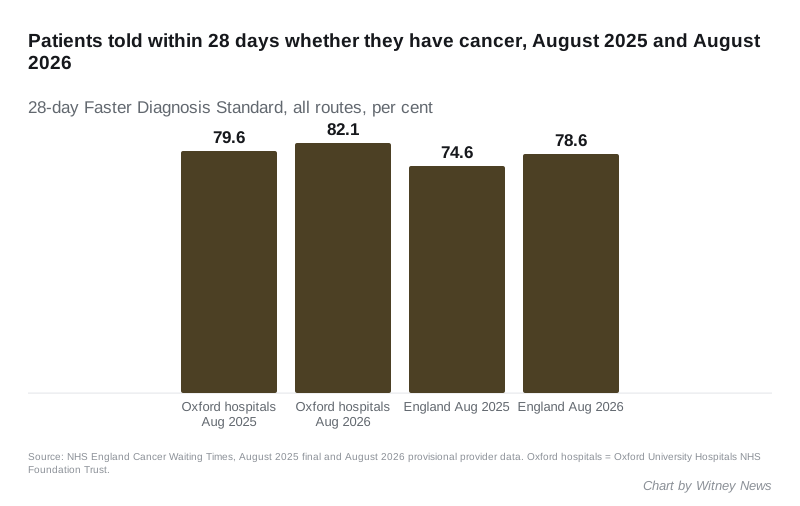
Patients urgently referred to Oxford’s hospitals with suspected cancer are finding out sooner whether they have it. In August, 82.1% were told within 28 days, up from 79.6% in August last year.
That is 2,575 of the 3,135 people whose referral was closed at Oxford University Hospitals NHS Foundation Trust in August, according to NHS England’s provisional Cancer Waiting Times data for August 2026. The trust runs the John Radcliffe, the Churchill, the Nuffield Orthopaedic Centre and the Horton General in Banbury, its website says.
The figures were sent to us today by the office of Sean Woodcock, the Labour MP for Banbury, whose seat takes in Chipping Norton, Charlbury and the Kingham, Rollright and Enstone ward, according to the ONS postcode directory.
What the MP said
Publishing the figures, Mr Woodcock said:
“Labour is getting our NHS back on its feet, and that’s good news for all us.
“In Oxfordshire, cancer diagnosis times are heading in the right direction, but we know there is a lot more to do. That’s why this Labour Government has developed the new National Cancer Plan to help three in four survive cancer by 2035.
“These aren’t just statistics. These are huge moments in the lives of people all over Oxfordshire. That’s why restoring our NHS is so important. We need a health service that is truly there when local people in Oxfordshire need it. That’s our goal, and that is what Labour will deliver.”
What the 28-day figure measures
The measure is the Faster Diagnosis Standard. It counts the share of patients urgently referred with suspected cancer who are told within 28 days whether they have cancer, or have it definitively ruled out, the MP’s office said.
The release describes a 2.5% improvement over the year. That matches NHS England’s data: the final August 2025 figures put the trust at 79.6% (2,614 of 3,284 patients), and the rise to 82.1% is 2.5 percentage points. The release’s notes give the earlier figure as 76.9%, which is not what the published August 2025 data shows; we have used NHS England’s number.
Oxford is ahead of England as a whole. Across all English providers, 78.6% of patients were told within 28 days in August 2026, against 74.6% a year earlier.
It depends on the cancer
The trust-wide figure hides a wide range. In August, by the suspected cancer the patient was referred for, the NHS England data shows:
- Skin: 93.5% told within 28 days (774 of 828), the largest group
- Breast: 92.8% (475 of 512)
- Head and neck: 81.8% (243 of 297)
- Urological: 76.9% (180 of 234)
- Lower gastrointestinal (bowel): 73.0% (243 of 333)
- Lung: 66.7% (30 of 45)
- Gynaecological: 57.3% (213 of 372), the lowest of the large groups
The two figures the release left out
Diagnosis is the first of three national cancer waiting time standards. The same NHS England data covers the other two at the trust.
Treatment within 62 days of referral improved further than diagnosis did. In August 2026, 66.2% of Oxford University Hospitals patients started their first treatment within 62 days of referral, up from 53.2% in August 2025. The national standard is 85%, and the NHS has not met it since 2014, the government said when it published the National Cancer Plan on 3 February.
Treatment within 31 days of the decision to treat went the other way, falling from 76.8% to 74.3% (768 of 1,034 treatments). Radiotherapy was the slowest: 60.3% of radiotherapy treatments in August started within 31 days.
What the National Cancer Plan promises
The government says the NHS will meet all three cancer waiting time standards by March 2029. The plan, as set out by the MP’s office and the government, includes:
- Faster diagnostics: a £2.3 billion investment to deliver 9.5 million additional tests by 2029, with more scanners, digital technology and automated testing. Where possible, community diagnostic centres will open 12 hours a day, seven days a week.
- Robot-assisted surgery: procedures to rise from 70,000 to half a million by 2035.
- Specialist centres: more patients with rarer cancers to have their care reviewed and treated at specialist cancer centres.
- Genomic testing: every patient who could benefit to be offered a test that analyses the DNA of their cancer.
- Waiting lists: new technology to offer patients the earliest available test appointment from a range of NHS organisations in their area.
What it means for you
If your GP refers you urgently with suspected cancer, the standard is that you are told within 28 days whether you have it or whether it has been ruled out. At Oxford’s hospitals, roughly four in five patients now get that answer in time, and about one in five still waits longer, with the longest waits on gynaecological, lung and bowel referrals.
If you are diagnosed, August’s figures suggest about two in three patients at the trust start treatment within 62 days of referral. The August 2026 figures are provisional and NHS England may revise them when it finalises the year.
Have your say