
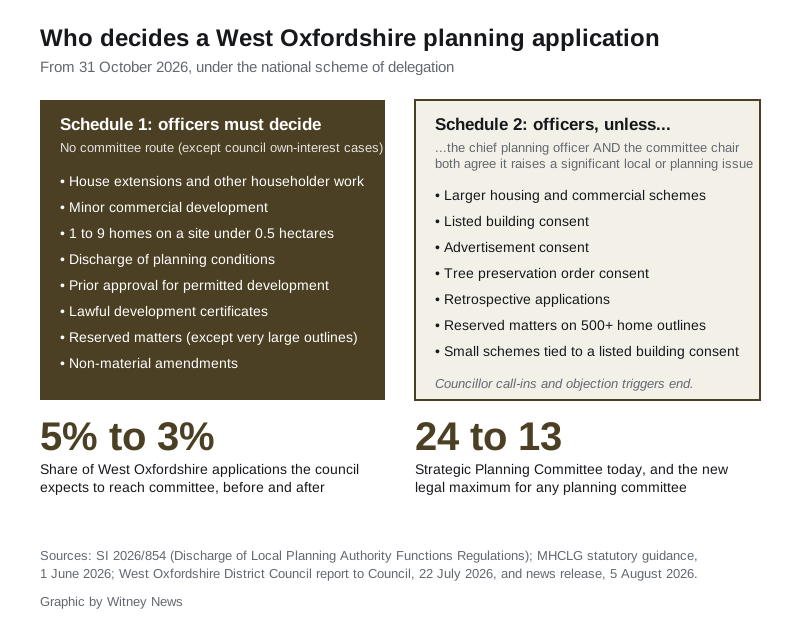
From 31 October your ward councillor can no longer send a planning application to committee. West Oxfordshire expects committee decisions to fall from 5% to about 3%, and its 24-member committee breaks a new cap of 13.
From 31 October 2026, most planning applications in Witney and West Oxfordshire will be decided by council officers with no route to a committee of elected councillors, and your ward councillor will lose the power to insist that one is. West Oxfordshire District Council estimates that the share of applications reaching committee will fall from around 5% to about 3%, and it says plainly that it thinks this is “a step backwards”.
The change is national. The Town and Country Planning (Discharge of Local Planning Authority Functions) (England) Regulations 2026, made on 15 July and in force from 31 October, put every planning function into one of two schedules and tell councils which they must delegate. The council cannot opt out: the government’s statutory guidance, published 1 June, warns that a committee decision on an application that should have gone to officers “may be subject to judicial review” and quashed.
What changes for a Witney application
Schedule 1 applications must be decided by officers. The guidance lists householder development (extensions, garages, dormers, the bulk of what appears on our weekly Witney planning applications list), minor commercial development, minor residential schemes of one to nine homes on sites under half a hectare, discharge of conditions, prior approval for permitted development, non-material amendments, lawful development certificates and reserved matters on all but the very largest outline permissions. None of these can go to committee unless the council itself has an interest in the application.
Schedule 2 applications are presumed to go to officers too. Larger housing and commercial schemes, listed building consent, advertisement consent, tree preservation order consent, retrospective applications and reserved matters on outlines of 500 or more homes can only be referred to committee if two people agree: the council’s nominated officer (the chief planning officer or equivalent) and the nominated member (the committee chair). Even then, the application must clear one of two statutory tests in regulation 5(3): it raises “an economic, social or environmental issue of significance to the local area”, or “a significant planning matter having regard to the development plan”. Where the two cannot agree, the guidance is blunt: “the case must be determined by officers”.
Two local levers disappear. The council’s report to its 22 July Full Council meeting says the regulations “remove many existing local discretionary arrangements currently contained within the Council’s Constitution”, naming two: “the ability for ward Members to request that applications be determined by committee, or for applications to be referred to committee because they have attracted a specified number of objections”. The government’s guidance confirms both are gone: such practices “will not be possible”, and a council that keeps them risks judicial review.
The council’s committee is too big for the new law
The regulations also cap any planning committee or sub-committee at 13 members. West Oxfordshire’s Strategic Planning Committee currently lists 24 councillors, and the council’s July report says consideration will be needed of “whether there will be a continuing need for a parent and sub-committee structure”. Its Development Management Sub-Committee sat most recently on 10 August.
The report to Full Council on 22 July recommended that councillors note it and ask the Constitution Working Group to work out how the council’s rules must change, reporting back to Council in September 2026. The next scheduled Full Council is 16 September, six weeks before the deadline. The report is candid about what officers are worried about: not just the size of the committee but “the support and protections available to Officers who will become solely responsible for determining a much wider range of often contentious planning applications”.
What the council says
Councillor Andy Graham, the council’s Leader, said in the 5 August statement: “We believe taking more decisions away from elected members is a step backwards. We have made our position clear with government, however, now the changes have been passed we will be required to comply with them from October.”
Councillor Liz Leffman, Executive Member for Planning and Infrastructure, said the council’s committees “have always applied a pragmatic and positive approach” and that “we have faith in our officers to make sound decisions, but this change will constrain the transparency and openness in the process this council values.”
The government’s case, as set out in the guidance, is consistency: committees “should focus on the key proposals that matter to an area, enabling other, often more minor and technical, decisions to be made by planning officers”. The council’s own report accepts there are “potential benefits”, including “improved certainty for applicants”, while calling the shift “a fundamental shift away from the long-established locally determined schemes of delegation towards a more technical, officer-led decision-making process, comparable in many respects to the Building Regulations regime”.
What it means for you
If you are objecting to a neighbour’s extension: from 31 October, it will be decided by an officer whatever you or your councillor do. Your comment still counts, because officers must weigh it against policy, but there will be no public debate at a committee. Comments go in through the council’s planning register as now.
If you are objecting to something bigger: the number of objections no longer triggers a committee hearing on its own. What matters is whether the chief planning officer and the committee chair agree it raises a significant local or planning issue. The guidance gives examples of what might qualify: a large multi-phase housing site allocated in the Local Plan, a change of use of a village shop, or works to a notable listed building in a town centre.
If you are applying: for householder and small schemes, the change removes the risk of a committee call-in and the delay that comes with it. The council’s planning applications page tracks what has been validated each week.
Watch for: the council must, as a minimum, keep and publish a record of the cases the two nominated people considered for referral and why they decided as they did, and report it to committee regularly. That register will be the only public trace of applications that might once have been debated in the Woodgreen council chamber. The regulations also require the government to review them by 31 October 2028.
The rules apply to any decision taken on or after 31 October 2026, including on applications submitted before then.
Have your say